The NAX Index – November 2026
Read More
Published: October 30, 2026
Last Updated: October 30, 2026
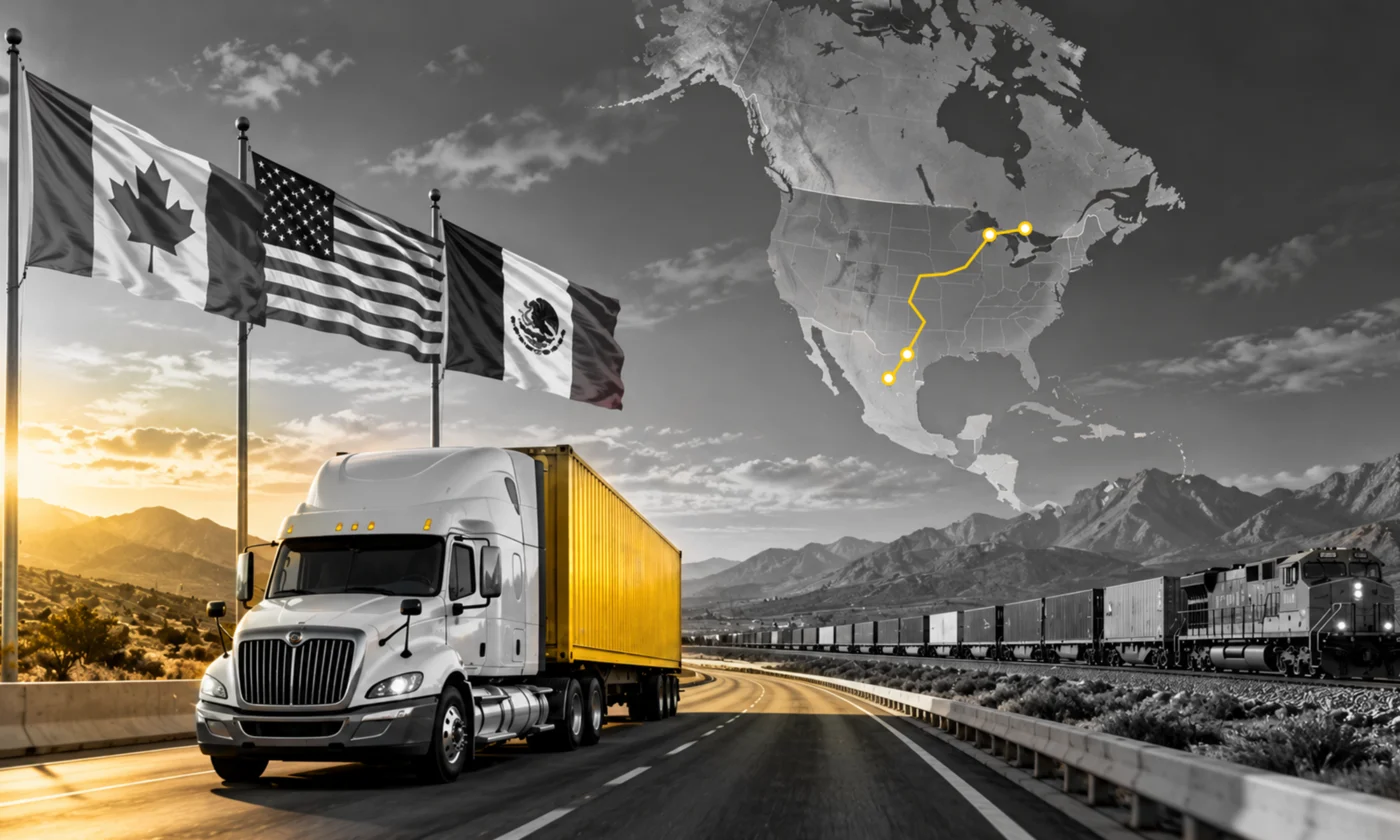
Moving freight over-the-road or by rail between Canada and Mexico means transporting cargo through three countries and across two international borders. Along the way, a shipment may involve multiple carriers and customs brokers, different customs requirements, and potential equipment or carrier handoffs before reaching its final destination.
Understanding where those transitions happen – and what needs to be arranged before the freight reaches them – can make Canada–Mexico transportation much easier to plan.
This article explains how freight typically moves between Canada and Mexico through the United States, what can happen at each stage of the journey, and how transportation, customs, carrier handoffs, and shipment visibility can be coordinated from pickup through final delivery.
For over-the-road freight, the United States provides the physical connection between Canada and Mexico. A southbound shipment may be picked up in Canada, cross the Canada–U.S. border, travel through the United States, cross the U.S.–Mexico border, and continue to its final destination in Mexico. Northbound freight follows the same general geographic path in reverse.
That does not mean one carrier or piece of equipment necessarily handles the shipment from beginning to end.
The operating model can vary based on the route, commodity, equipment, carrier network, and requirements at each border. A shipment may use different carriers for the Canadian, U.S., and Mexican portions of the move. Equipment may also be transferred or exchanged at certain points along the route.
Before the first truck arrives for pickup, shippers should understand how the complete journey is expected to work, including where border crossings and handoffs will occur, who will handle each transportation leg, which customs brokers will be involved, and what needs to happen before the freight can continue.
For freight moving directly between Canada and Mexico, the United States functions as a transit country rather than the shipment’s final market.
Depending on how the shipment is structured, freight traveling through the U.S. for subsequent export may move under U.S. Customs and Border Protection (CBP) in-bond procedures. The specific customs requirements depend on the shipment and should be established with the appropriate customs professionals before the freight departs.
Transportation still needs to be planned around that customs process. The U.S. carrier must have the information and documentation required for its portion of the move, while the transportation and customs arrangements for the next border should be in place before the shipment gets there.
For example, a southbound load leaving Ontario may cross into the United States and travel through the country before reaching the U.S.–Mexico border. While the U.S. leg may account for a significant portion of the mileage, it is still only one part of a larger Canada-to-Mexico movement.
When freight is traveling between Canada and Mexico through the United States, a bonded carrier can transport eligible cargo through the U.S. under customs control without the goods being entered for consumption in the U.S.
For example, freight moving from Canada through the United States for delivery in Mexico may move under a Transportation and Exportation (T&E) in-bond entry. This allows the cargo to travel through the U.S. for export to Mexico without U.S. duties being paid, provided the applicable customs requirements are met. The reverse can apply to qualifying freight moving from Mexico through the U.S. to Canada. You can find a list of bonded Canadian carriers here.
Using a bonded carrier does not eliminate the customs process. The in-bond movement must be properly filed and tracked, and the required arrival and export information must be reported to U.S. Customs and Border Protection (CBP). The carrier transporting the bonded freight also assumes responsibility for the merchandise while it is moving under the bond.
This makes carrier selection an important part of planning the U.S. transit leg. If freight is expected to move in bond, the transportation provider handling that portion of the journey needs the appropriate bonding and processes in place before the shipment enters the United States.
Planning the in-bond movement alongside the Canadian and Mexican customs requirements helps keep the U.S. transit leg connected to the broader shipment rather than treating it as a separate import into the U.S.
There is no single operating model for every Canada–Mexico shipment.
Depending on the carriers and services involved, freight may change transportation providers during its journey. A Canadian carrier may handle the first portion, a U.S. carrier the transit leg, and a Mexican carrier the final leg. Other operating models may involve fewer or different handoffs.
The U.S.–Mexico border can also involve different equipment-transfer arrangements. Depending on the shipment and carrier network, a trailer may continue across the border with a different tractor, or freight may be transferred to different equipment before continuing to its destination.
These transitions should be identified when the shipment is planned. Teams need to know where the handoff will take place, which provider is responsible for the next move, when the freight is expected to become available, and whether appointments, facilities, or specialized equipment are required.
Consider a load of automotive components moving from Ontario to a manufacturing facility in Monterrey. Before the Canadian carrier picks up the load, the U.S. transit leg, customs requirements, border arrangements, Mexico capacity, and delivery requirements can already be established. If the freight changes carriers or equipment along the route, the next provider receives the shipment details and timing needed to continue the move.
Each international border has its own customs requirements, and the requirements for entering Canada, the United States, or Mexico are not interchangeable.
The parties involved can also change throughout the journey. Depending on the shipment, importers, exporters, customs brokers, carriers, and other providers may each be responsible for different information or documentation.
That makes advance planning particularly important on a three-country move. A shipment successfully clearing one border does not automatically mean everything is ready for the next.
Before departure, teams should understand the planned border crossings, customs responsibilities, documentation requirements, carrier arrangements, and what needs to occur before the shipment is released to continue.
The same principle applies to trade-agreement eligibility. The Canada-United States-Mexico Agreement (CUSMA/USMCA/T-MEC) can provide preferential tariff treatment for qualifying goods, but moving between the three countries does not by itself make a product eligible. Rules of origin and other applicable requirements still need to be satisfied.
End-to-end visibility means knowing more than where a shipment is located. Teams also need to understand whether it is progressing as planned and whether a change at one stage will affect what happens next.
Pickup and delivery status, estimated arrival times, customs milestones, border status, handoffs, and transportation exceptions can all help provide that picture.
More importantly, that information needs to reach the people who can act on it.
A manufacturing facility can use an updated arrival time to adjust production or material planning. A distribution center can use it to schedule dock space and labor. Customer service teams can communicate a revised delivery expectation instead of waiting for the shipment to miss its appointment, while transportation teams can determine whether a downstream carrier or appointment needs to be adjusted.
The value of visibility is therefore not simply having more shipment data. It is having the information early enough to make a decision.
A Canada-Mexico move can involve several organizations and transfer points. Carriers handle the physical transportation, customs brokers support the clearance process, warehouses may receive or stage freight between moves, and logistics providers help connect those activities across the route.
The information passed between those partners is particularly important at transition points.
A carrier arriving for the next leg may need confirmation that the shipment is available for pickup and cleared to continue. A warehouse may need inbound timing and outbound pickup information before the load arrives at its facility. A receiver may need an updated arrival time so that labor, equipment, or dock space is available.
Clear responsibilities also make exceptions easier to address. When something changes, the information needs to reach the partners whose plans are affected.
Strong partnerships and coordinated communication make those dependencies easier to manage because each organization understands both its own responsibility and the information the next party needs to continue the shipment.
The geographic journey is essentially reversed when freight moves northbound, but the operational and customs requirements should not be assumed to work exactly the same way.
A northbound shipment may leave a supplier or manufacturing facility in Mexico, cross into the United States, travel north through the U.S., enter Canada, and continue to its final destination. Carrier and equipment handoffs can occur along the way just as they can on a southbound shipment.
However, the importer, exporter, commodity, customs requirements, documentation, carrier network, and border processes may differ.
This is why companies moving freight regularly in both directions benefit from planning each lane based on its specific requirements rather than simply reversing the southbound transportation plan.
A manufacturer, for example, may ship raw materials or components south to a plant in Mexico and later move finished goods north for distribution in Canada. Those shipments are connected to the same supply chain, but each direction needs its own transportation and customs plan.
A well-executed North American transportation strategy can reduce the time teams spend resolving handoff issues, searching for shipment updates, and adjusting downstream plans after a change has already occurred.
Establishing the route, customs requirements, carrier capacity, handoffs, appointments, and shipment visibility in advance helps keep each leg connected to the next. Whether freight is moving south to a manufacturing facility in Mexico or returning north for distribution in Canada, an end-to-end plan gives teams a clearer picture of what needs to happen from pickup through final delivery.
With clearer responsibilities, and better-defined handoffs, businesses can make transportation decisions sooner, and build a transportation network that can support changing volumes and routes as the business grows.
Moving freight across North America? Talk to TRAFFIX about your transportation needs.