Why Transportation Planning Should Follow Solar Construction Schedules
Read More
Published: October 16, 2026
Last Updated: October 8, 2026

Expedited transportation has a reputation for being one of the most expensive ways to move freight. But faster doesn’t automatically mean more expensive. Depending on the shipment, delivery window, distance, and equipment required, expedited transportation can sometimes cost about the same as – or even less than – other options.
A smaller expedited vehicle may be more economical than paying for capacity a shipment doesn’t need. Expedited ground may be able to meet a delivery deadline without the added cost of air freight. And when expedited does carry a higher rate, that rate is only one part of the cost equation. Production downtime, missed customer commitments, lost sales, or other consequences of a late delivery can quickly outweigh the additional transportation expense.
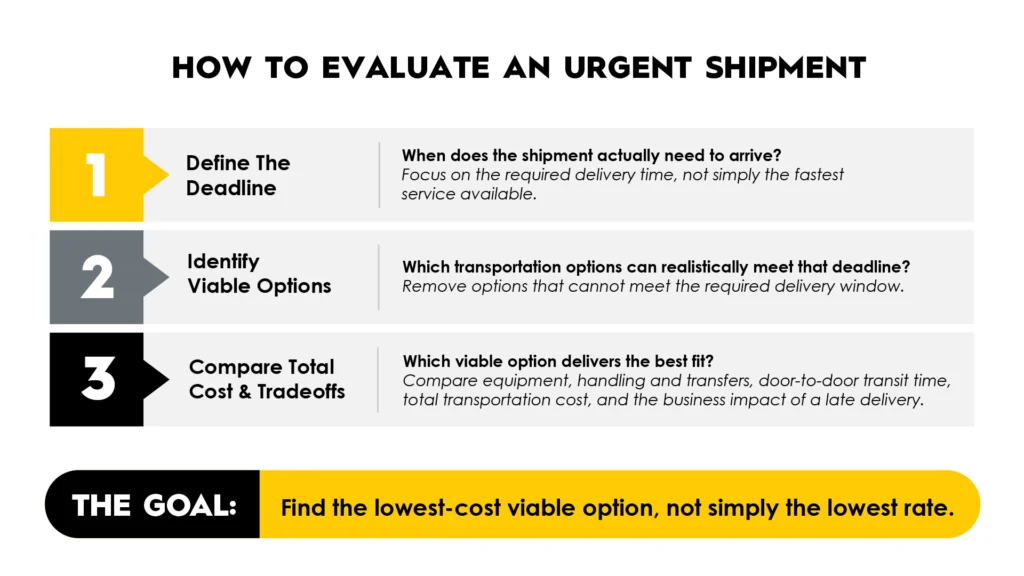
The right comparison isn’t simply which transportation option has the lowest rate. It’s which option can meet the shipment’s requirements at the best overall cost.
As stated in the introduction, expedited doesn’t always mean more expensive. When expedited transportation does carry a higher rate, the additional cost typically reflects the resources required to meet a tighter delivery window and the level of service needed to manage the shipment.
Equipment availability and positioning can affect the rate. Expedited shipments are often booked with little advance notice, which gives carriers less time to find and position the right equipment. If an appropriate vehicle isn’t already available near the pickup location, it may need to travel empty – or “deadhead” – to reach the freight. The farther that equipment needs to be repositioned, the more it can affect the cost of the move.
Some delivery windows require additional drivers. Longer-distance shipments with aggressive delivery requirements may require team service. By alternating driving and required rest periods, team drivers can keep a truck moving for more hours each day than a single driver can, allowing freight to cover greater distances within a shorter delivery window. The additional driver and operating requirements are reflected in the transportation rate.
Critical shipments can also require more hands-on management. Expedited loads are often closely monitored throughout transit, with frequent communication between the transportation provider and driver and proactive updates to the customer. When a late delivery could shut down a production line, delay a launch, or disrupt a customer’s operations, that level of oversight becomes particularly important. The transportation team isn’t simply arranging capacity; they’re actively managing the shipment against a critical deadline – sometimes 24/7 until delivery is complete.
Specialized equipment, strict pickup or delivery appointments, additional handling requirements, and other shipment-specific needs can further affect the available capacity and amount of coordination required.
When expedited transportation costs more – the difference isn’t simply a premium charge for faster transit. The rate can reflect the equipment, driver resources, positioning, active shipment management, and level of service required to meet a time-critical delivery.
One reason expedited transportation isn’t always the most expensive option is that “expedited” doesn’t describe a single type of equipment. The right solution depends on how much freight needs to move, its dimensions and weight, the distance between pickup and delivery, and how much time is available to complete the trip.
Sprinter vans can be a cost-effective option for smaller, time-critical shipments that don’t require the capacity of a straight truck or tractor-trailer. They are commonly used for a few pallets, parts, components, or other relatively small shipments that need to move directly from origin to destination. Because the shipper isn’t paying to move a much larger vehicle than the freight requires, a sprinter van can sometimes make expedited transportation surprisingly economical.
Straight trucks provide more capacity than a sprinter van without requiring a full tractor-trailer. They can be a good fit for larger expedited shipments that still don’t require a full 53-foot trailer. Availability can vary by market and equipment specification, however, and a truck may need to travel some distance to reach the pickup location. That positioning can influence the rate.
Hot shots are typically used for urgent freight that requires open-deck equipment, including machinery, construction materials, industrial components, and other freight that may not be suitable for an enclosed vehicle. Cost can vary significantly depending on the equipment required, shipment dimensions and weight, distance, and how readily the appropriate hot-shot capacity is available in the market.
Team-service full truckload becomes an option when a shipment requires the capacity of a tractor-trailer but needs to travel farther or faster than a solo driver can reasonably accommodate within the required delivery window. Two drivers alternate driving and rest periods so the truck can remain in motion for more hours each day. The additional driver makes team service more expensive than comparable solo-driver truckload service, but it can provide an over-the-road alternative when the delivery deadline is particularly tight.
Expedited air is generally considered when the available delivery window cannot realistically be met over the road. Air can dramatically reduce linehaul transit time over long distances, but the shipper may also need to account for transportation to and from airports, handling, flight schedules, shipment size and weight, and other air-freight charges. For that reason, it is worth determining whether the delivery deadline truly requires air or whether an expedited ground option can meet the same deadline.
Comparing the options requires looking at the actual shipment and delivery deadline rather than assuming one expedited service will always cost more than another.
An urgent shipment doesn’t necessarily need to move by air. Before booking a flight, consider how many hours are actually available between the time the freight is ready for pickup and when it needs to arrive.
For example, a shipment that is ready late Friday and needs to travel across the country for delivery Monday morning may initially seem like an obvious candidate for air freight. However, the weekend creates a longer continuous transit window. Depending on the origin, destination, and exact delivery requirement, an expedited ground solution such as team-service truckload may have enough time to complete the trip.
That distinction can have a significant impact on transportation cost, particularly for larger and heavier shipments. Air freight pricing is influenced by shipment weight and dimensions and can also include pickup and delivery transportation, handling, and other charges associated with moving freight through the air network. When ground can meet the same deadline, comparing the two options may reveal a considerably less expensive way to achieve the required delivery.
There are also times when the decision is straightforward. If the distance is too great for a ground vehicle to cover within the available hours, air may be the only practical option.
The key is to work backward from the required delivery time rather than automatically equating urgency with air freight. If both modes can meet the deadline, then cost, shipment requirements, handling, and other service considerations can determine which option makes the most sense.
When expedited transportation costs more than a standard shipping option, the difference in freight rate is only one part of the cost comparison. The more important question is what happens – and what it could cost the business – if the shipment doesn’t arrive on time.
Consider a manufacturer waiting for a replacement part needed to restart an assembly line. The cost of a late shipment could include hours (or even days) of lost production, idle employees, missed production targets, and downstream delays to customer orders. In that situation, an additional transportation expense may be relatively small compared with the cost of extending the shutdown.
The same calculation can look very different in other industries.
There can also be consequences that are harder to quantify. Missing an important customer delivery could affect service commitments, create additional work for the customer’s operations team, or damage confidence in the supplier.
This doesn’t mean every important shipment should be expedited. It means the transportation decision should reflect the financial and operational consequences of being late. If an expedited option costs $1,000 more but helps protect the business from a disruption that could cost tens of thousands of dollars, the higher freight rate may ultimately be the less expensive decision.
Expedited transportation doesn’t automatically mean paying the highest price to move freight faster. Depending on the shipment, a smaller expedited vehicle may cost less than other available equipment, expedited ground may provide an alternative to air, and a higher transportation rate may be justified when the cost of arriving late is significantly greater.
The key is to start with what the shipment actually requires: when it needs to arrive, how far it needs to travel, what equipment can accommodate it, and what happens if it misses the deadline. From there, shippers can compare the options capable of meeting those requirements rather than making assumptions based on the service label or quoted rate alone.
Ultimately, the least expensive transportation decision isn’t always the one with the lowest rate. It’s the one that delivers the required outcome at the best overall cost.
Have a time-critical shipment? Talk to a TRAFFIX expedited transportation expert about your options.