Shipping Between Canada and Mexico: How to Move Cargo Seamlessly Across Three Countries
Read More
Published: November 4, 2026
Last Updated: November 4, 2026

Solar equipment should be stored according to the manufacturer’s requirements in a dry, secure location that protects it from environmental exposure, physical damage, unauthorized access, and unnecessary handling. The right storage conditions depend on the equipment being stored, how long it will remain there, and whether it is being staged at the project site or an off-site facility.
For utility-scale projects, storage is also an important part of construction logistics. Where equipment is staged can affect truck access, material handling, site traffic, and how efficiently crews can move materials into installation.
In this article, we’ll explain how to plan solar equipment storage before deliveries begin, what to consider when selecting staging areas, how storage requirements differ by equipment type, and how coordinating deliveries with construction progress can reduce unnecessary handling and storage time.
Solar projects rarely move in a perfect linear sequence. Civil work may take longer than expected; weather can affect site readiness, installation priorities can shift, or equipment may arrive before the area where it will be installed is ready.
That makes storage part of the logistics plan, not something to figure out once trucks begin arriving.
Before scheduling deliveries, project teams should understand where equipment will be received, how much material the site can safely accommodate, what equipment is available for unloading and handling, and how materials will move from the storage area to the installation location.
This becomes especially important on utility-scale projects receiving multiple truckloads over a short period. If material arrives faster than crews can install it, staging areas can fill quickly. That can create additional handling requirements, restrict truck or construction traffic, and force equipment to be relocated later.
Planning storage capacity alongside the delivery schedule gives teams a better understanding of how much equipment the site can realistically receive at each stage of construction.
Solar panels should generally remain in their original manufacturer-approved packaging until they are needed for installation. Storage conditions should always follow the module manufacturer’s requirements, including any instructions related to stacking, orientation, environmental exposure, or maximum storage duration.
When panels are staged outdoors, the storage area should have stable, level ground and adequate drainage so pallets are not exposed to standing water, unstable surfaces, or other site hazards. Packaging should also be inspected periodically, particularly after severe weather or if panels will remain in storage for an extended period.
The location of the storage area matters as much as its physical condition. A convenient open area may work for the first few deliveries but become problematic as construction progresses. Project teams should consider:
Ideally, storage should reduce movement rather than create another transportation step within the job site. Staging panels near the areas where they will ultimately be installed, when site conditions allow, can help reduce repeated handling.
Solar projects involve more than panels, and different components may have different storage requirements.
Inverters, transformers and other electrical equipment, batteries, trackers, racking systems, and smaller components like cables and connectors, should be stored according to their manufacturers’ specifications. Some equipment may require additional protection from moisture, dust, temperature extremes, direct sunlight, or prolonged outdoor exposure than solar modules themselves.
Sensitive electrical equipment may require indoor or covered storage, while other materials may be suitable for outdoor staging when properly packaged and protected. Battery energy storage equipment can have particularly specific requirements related to temperature, environmental conditions, handling, and safety, making manufacturer instructions and applicable project procedures especially important.
Smaller components should also remain organized and identifiable. Losing track of connectors, hardware, or installation-specific materials can create delays even when major equipment has arrived on schedule.
A defined inventory system can help teams identify incoming materials, where they are stored, and which installation area or construction phase they support.
Storage planning does not end when equipment is unloaded.
Incoming equipment and its packaging should be inspected for visible signs of damage before it is placed into storage. Any damaged packaging, shifted loads, moisture exposure, or other concerns should be documented according to the project’s receiving and claims procedures.
Maintaining accurate receiving records also gives project teams visibility into what is physically on site or at an off-site facility. For large projects receiving equipment across dozens or hundreds of shipments, knowing that a component was delivered is not enough. Teams also need to know where it was staged and whether it remains in acceptable condition.
This is particularly important when materials will remain in storage for an extended period or move through multiple staging locations before installation.
Careful receiving, documentation, and handling can also help reduce the risk of damage throughout the equipment’s journey. For more on this topic, read our article – Solar Panel Packaging & Handling Best Practices.
Every additional movement creates another opportunity for equipment to be damaged.
A pallet that is unloaded into temporary storage, moved again when the staging area becomes crowded, and then transported to the installation area goes through significantly more handling than one staged with its final destination in mind.
Repeated movement can also consume labor and handling equipment while increasing traffic within an already active construction site.
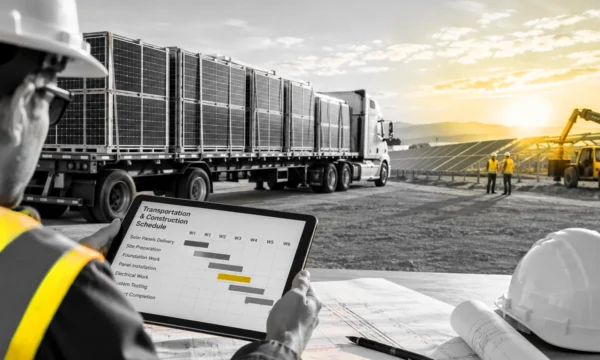
Reducing those movements requires coordination between transportation and construction teams. Delivery sequencing can be aligned with installation priorities, so equipment arrives closer to when and where it will be needed.
Temporary storage may still be necessary, but it should be planned rather than become the default when deliveries get ahead of construction.
Not every project has enough space to receive equipment at the same pace it is produced or transported.
Off-site warehousing or staging can provide additional flexibility when construction is delayed, on-site storage capacity is limited, large volumes of equipment are arriving within a short period, or the project needs greater control over the pace of final deliveries.
Instead of sending every inbound shipment directly to the construction site, equipment can be received at an appropriate staging facility and released as installation progresses.
However, off-site storage also introduces another handling and transportation step. Project teams should consider the storage requirements of the equipment, facility capabilities, inventory controls, handling procedures, security, and the transportation required to move materials from the facility to the project site.
The objective is not simply to find somewhere to hold equipment. It is to create a controlled buffer between inbound supply and what the construction site can realistically receive.
Even with careful planning, site conditions can change after transportation has been scheduled.
If a job site cannot safely receive or store incoming equipment, project teams may need to adjust delivery appointments, hold equipment at an off-site warehouse or staging location, or temporarily changing the delivery sequence.
These options are easier to manage when they have been considered before equipment is already in transit. Waiting until a truck reaches a site that cannot receive it can lead to detention, layovers, redelivery or rescheduling charges, additional handling, and other avoidable costs.
Communication between construction teams, suppliers, storage facilities and transportation partners is especially important as delivery dates approach. Updated information about site conditions allows transportation plans to change before a truck is dispatched rather than after it reaches the project.
One of the most effective ways to simplify storage is to reduce how long equipment needs to remain in storage in the first place.
Rather than allowing manufacturer or supplier availability alone to dictate the final delivery schedule, project teams can coordinate shipments with construction progress and installation capacity. If crews can install a certain number amount of equipment each day or week, inbound transportation can be planned around that pace instead of filling the site with material weeks before it is needed.
This requires visibility into changing site conditions. Weather delays, crew availability, civil work, and equipment readiness can all affect how much material a site can realistically receive.
Transportation plans that can adjust with those conditions give project teams more flexibility to manage inventory at the job site without disrupting the overall project schedule.
For a deeper look at this process, read Why transportation planning should follow solar construction schedules.
Solar equipment storage is most effective when planned as part of the broader transportation and construction strategy rather than treated as a separate step after materials arrive.
Manufacturer requirements should determine how individual components are protected, while site capacity, installation sequencing, handling requirements, and construction progress should help determine where and for how long equipment is stored. When on-site capacity is limited or schedules change, planned off-site staging can provide another option for controlling the flow of materials into the project.
The goal is to keep equipment protected, accounted for, and positioned to move efficiently toward installation with as little unnecessary handling as possible.
TRAFFIX works with renewable energy project teams to coordinate transportation around construction schedules, site requirements, and changing delivery needs.
By planning transportation and staging together, teams can keep equipment moving toward installation rather than from one temporary location to another.
Contact TRAFFIX to discuss transportation planning for your next solar project.