The Complete Guide to Flatbed Transportation
Read More
Published: July 17, 2026
Last Updated: July 17, 2026

Storage refers to keeping freight in a facility until it is needed. Its primary purpose is to hold inventory for a period of time, whether for short- or long-term needs, rather than actively managing inventory or moving freight through the supply chain.
While storage is one part of warehousing, modern warehouse operations also support:
Receiving and Unloading
The warehousing process begins when inbound freight arrives at the facility. Shipments are unloaded, documented, and checked against shipping records to ensure the correct products and quantities have been received. Efficient receiving processes help prevent delays, reduce errors, and keep inventory flowing smoothly through the supply chain.
Inspection and Condition Verification
Before products are stored or moved through the fulfillment process, they may undergo inspections to verify their condition, labeling, packaging, temperature requirements, or regulatory compliance. Identifying and reporting damages is a key component of verifying the condition of the freight upon receipt. This helps prevent costly disruptions and ensures products meet customer and operational standards.
Put-Away and Freight Zoning
Once received, goods are organized and stored in designated warehouse locations based on product type, demand patterns, and operational requirements. Strategic inventory placement improves accessibility, supports efficient order fulfillment, and maximizes warehouse space utilization.
Order Picking, Packing, Labeling
When customer orders are received, warehouse teams pick the required products, prepare them for shipment, and apply the appropriate labels and documentation. This is where freight becomes a shipment again. Accurate picking and packing processes help reduce fulfillment errors, improve delivery performance, and support a positive customer experience.
Dispatch & Carrier Appointments
Warehouses play a critical role in preparing outbound shipments and coordinating transportation schedules. Orders are consolidated, staged, and loaded for pickup while carrier appointments and shipping documentation are managed to help ensure freight moves efficiently to its next destination.
Returns & Reverse Processing
Many warehouses also support reverse logistics activities, including returns processing, product inspections, refurbishment, repackaging, and inventory disposition. An effective returns process helps businesses recover value, maintain inventory accuracy, and improve customer satisfaction.
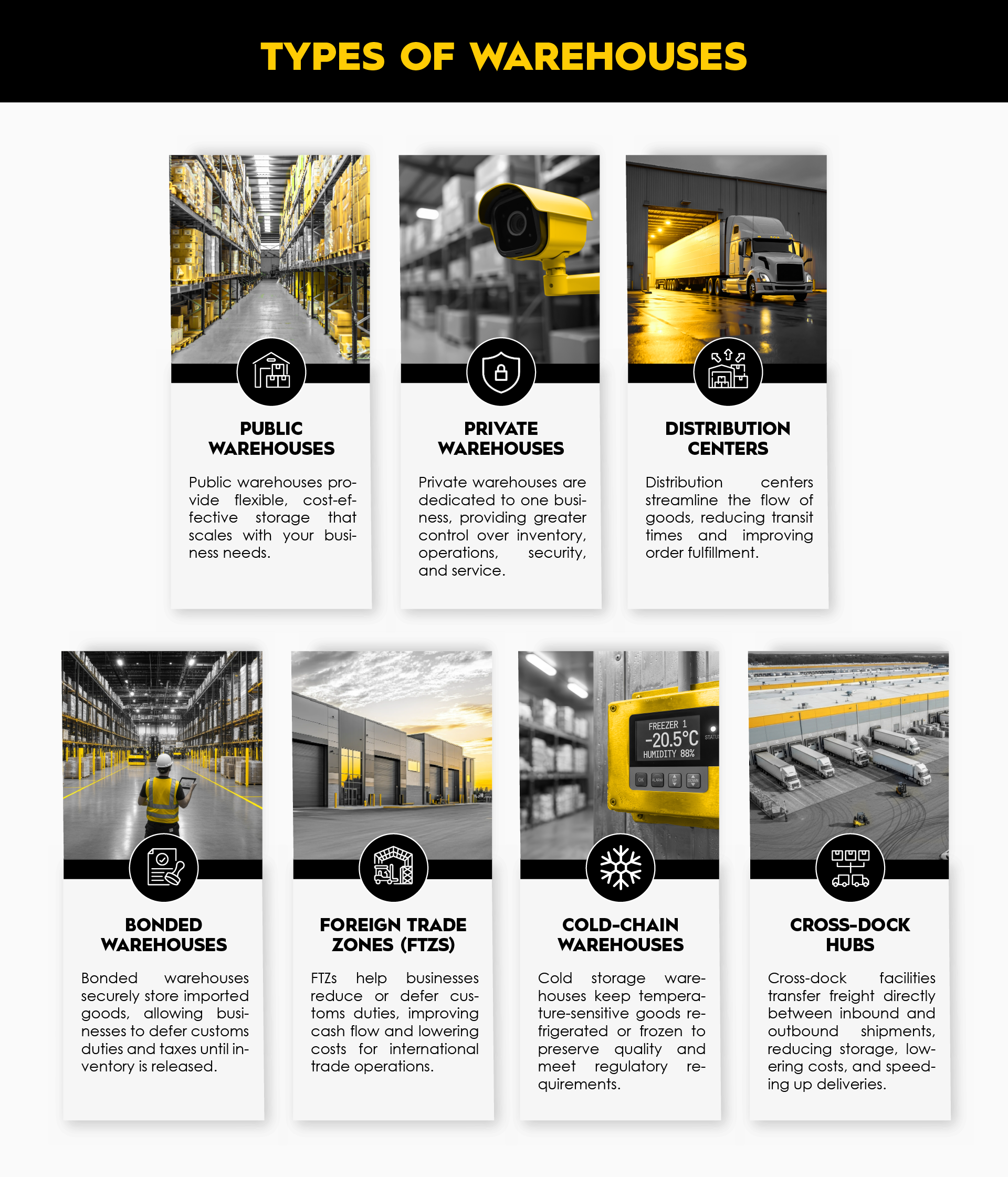
Public Warehouses
Public warehouses provide shared storage space that businesses can scale up or down based on demand. This flexibility makes them a cost-effective solution for companies with seasonal inventory fluctuations, changing storage requirements, or growing distribution needs without the commitment of a dedicated facility.
Private or Dedicated Warehouses
Private warehouses are owned or leased by a single organization and are designed to support its specific operational requirements. They offer greater control over inventory management, workflows, security protocols, and service levels, making them a popular choice for businesses with high-volume or complex warehousing needs.
Distribution Centers
Distribution centers are designed to move products efficiently through the supply chain rather than store them long term. These facilities receive, sort, consolidate, and ship inventory to retail locations, distribution partners, or end customers. By being strategically located it helps businesses reduce transit times and improve order fulfillment performance.
Bonded Warehouses
Bonded warehouses are secure facilities authorized to store imported goods before customs duties and taxes are paid. Businesses can defer duty payments while inventory remains in storage, providing greater flexibility for managing international shipments and cross-border supply chains.
Foreign Trade Zones (FTZs)
Businesses operating within FTZs may benefit from deferred, reduced, or eliminated customs duties, helping improve cash flow and lower overall supply chain costs. These facilities are commonly used by organizations managing international trade, cross-border operations, or complex import and export activities. For businesses looking to optimize duty management and inventory strategies, FTZs can provide significant operational and financial advantages.
Cold-Chain Warehouses
Cold storage warehouses maintain controlled temperature environments for products that require refrigeration or freezing. Commonly used for food, beverages, pharmaceuticals, and other temperature-sensitive goods, these facilities help preserve product quality and maintain regulatory compliance throughout the supply chain.
Cross-Dock Hubs
Cross-dock facilities are designed to transfer freight directly from inbound shipments to outbound transportation with minimal or no storage time. By reducing handling requirements and shortening dwell times, cross-docking can help improve supply chain efficiency, lower storage costs, and accelerate delivery timelines.
Technology plays a critical role in modern warehousing by improving inventory accuracy, increasing visibility, and supporting more efficient warehouse operations. Rather than replacing operational expertise, warehouse technology helps teams make faster, more informed decisions while reducing manual processes and errors.
Common warehouse technologies include:
When integrated effectively, these technologies help warehouses improve inventory control, increase operational efficiency, reduce fulfillment errors, and provide greater supply chain visibility.
Warehousing plays a critical role in helping businesses move freight efficiently between Canada, the United States, and Mexico. While transportation moves goods across borders, warehouses provide the infrastructure needed to manage inventory, support customs requirements, and maintain reliable order fulfillment throughout the supply chain.
Strategically located warehouses can help businesses position inventory closer to customers and major transportation corridors. This can reduce transit times, improve service levels, and create greater flexibility when demand fluctuates. Many companies also use warehousing to support inventory replenishment strategies, regional distribution networks, and e-commerce fulfillment operations.
Warehouses also support customs and compliance activities that are essential to cross-border trade. Bonded warehouses allow imported goods to be stored before duties and taxes are paid, while inventory management systems help maintain accurate records and shipment visibility. These capabilities can help streamline customs processes and support smoother freight movement across international borders.
Warehousing is about more than simply storing inventory. To support efficient transportation and distribution, warehouses must be designed to keep freight moving smoothly through every stage of the supply chain. This requires careful coordination between inventory management, facility operations, transportation providers, and compliance requirements.
By addressing these factors, businesses can improve supply chain efficiency, reduce delays, and create a more reliable flow of goods from origin to destination.
Effective warehousing is about more than where products are stored – it’s about how inventory moves through the supply chain. From receiving and storage to fulfillment, customs support, and distribution, warehouses help businesses maintain inventory visibility, improve operational efficiency, and support reliable freight movement.
As supply chains become more complex, warehousing continues to play an important role in connecting inventory, transportation, and customer demand. Businesses that align their warehousing and transportation strategies are better positioned to improve service levels, increase flexibility, and support long-term growth.
Warehousing helps businesses manage inventory, improve order fulfillment, support transportation planning, and create greater supply chain flexibility.
In addition to storage, warehouses can provide services such as inventory management, cross-docking, order picking and packing, customs support, and distribution. The right warehousing strategy can help reduce delays, improve visibility, and keep products closer to customers.
Talk to a warehousing expert today to learn more.
Both play an important role. Cold chain integrity begins in the warehouse, where temperature-sensitive products are received, stored, and staged in controlled environments.
Refrigerated transportation then maintains those temperature requirements throughout transit. A successful cold chain strategy requires coordination between warehousing and transportation providers.
If you need support with your cold chain strategy, connect with our warehousing team today!
No. Cross-docking is often used as a proactive strategy to improve efficiency and reduce storage requirements. By transferring freight directly from inbound shipments to outbound transportation, businesses can reduce handling costs, accelerate delivery times, and move products through the supply chain more quickly.
Explore how cross-docking can support your distribution and transportation strategy – talk to an expert today.
Warehousing can have a significant impact on transportation performance. Efficient receiving, inventory management, order processing, and shipment staging help ensure freight is ready when carriers arrive. Well-coordinated warehouse operations can reduce delays, improve transit reliability, and support on-time deliveries.
Learn how integrated warehousing and transportation solutions can improve supply chain performance – book your consultation today.
A bonded warehouse is a secure facility that allows imported goods to be stored before customs duties and taxes are paid. This can provide businesses with greater flexibility when managing international inventory and cross-border shipments. Bonded warehousing is commonly used to support import, export, and cross-border logistics operations.
Discover how bonded warehousing can support your cross-border supply chain strategy – talk to an expert.
Not necessarily. Many businesses achieve excellent visibility and cost control through shared warehousing solutions supported by strong processes, inventory management systems, and performance reporting. The best option depends on your inventory volumes, operational requirements, and growth plans.
Talk to a TRAFFIX warehousing expert about selecting the right warehousing model for your business.