The Complete Guide to Flatbed Transportation
Read More
Published: October 1, 2025
Last Updated: May 12, 2026

In the transportation and logistics industry, the choice between asset-based carriers and brokers can significantly impact a shipper’s supply chain. Factors such as service quality, capacity, geographic coverage, reliability, and cost-effectiveness are all influenced by this decision.
Both asset-based carriers and brokers offer distinct advantages and are suited for different scenarios. This article will explore their key differences and help you determine which option is best to meet your shipping needs.
Asset-based carriers own their trucks and may either own or lease trailers and other equipment used to transport goods. These carriers can offer one or multiple modes of service, including full truckload, less-than-truckload (LTL), temperature-controlled shipments, drayage, and open-deck moves, such as hot shots, flatbeds, and step-decks.
Asset-based carriers are typically categorized into three classes: long-haul, regional, and local carriers.

Truck drivers are generally categorized as either company drivers or owner-operators. While a company driver is employed by an asset-based transportation company, an owner-operator is an independent driver who owns their equipment and operates their own transportation business.
Owner-operators may own one or more pieces of equipment and are typically the primary driver of at least one of those assets. Unlike company drivers, these independent entrepreneurs have the flexibility to choose their own freight. However, they are responsible for all operating expenses and must independently find their own loads, whereas company drivers rely on their employer to source, negotiate, and coordinate shipments and to cover all maintenance costs for the equipment.
To manage this responsibility, many owner-operators—and sometimes smaller asset-based carriers—employ dispatch services. These professional dispatchers help locate, negotiate, and coordinate shipments, making them especially valuable for businesses with limited staffing or those aiming to keep headcount low.
A broker acts as an intermediary that connects shippers with available carriers. While some brokers may own assets, generally they rely on a network of carriers to fulfill loads.
Brokers utilize their carrier network to match shippers with available capacity, providing flexibility to handle unexpected shipments or volatile market conditions.
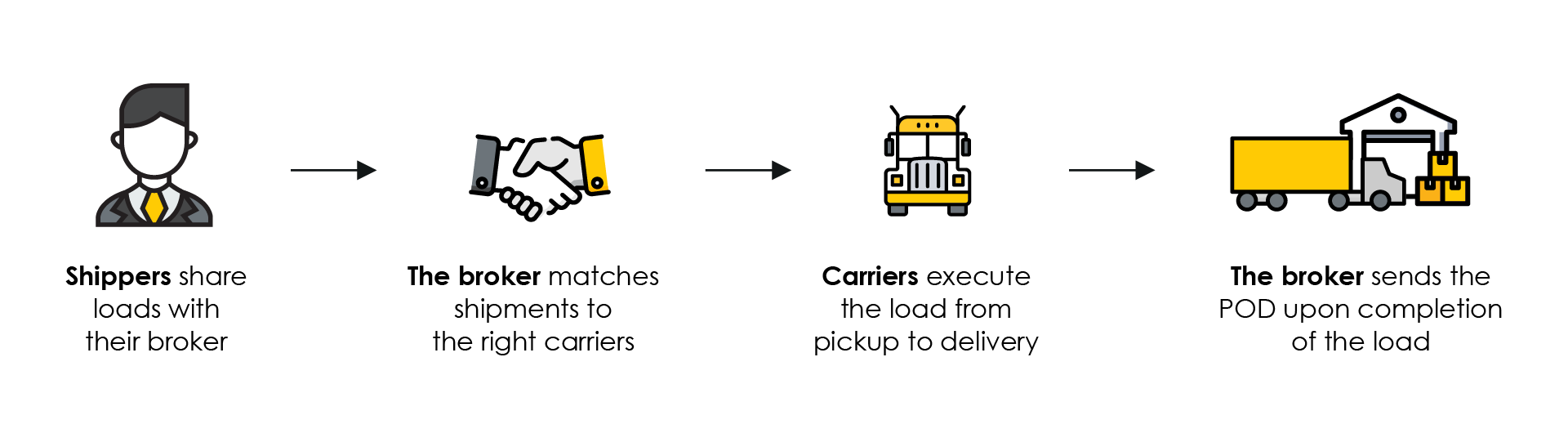
The next diagram shows how the freight brokerage process works in four simple steps. The shipper submits the load, the broker matches it with the right carrier, and once a carrier is assigned, the freight is on its way to a successful delivery. Each step highlights the vital role of shippers, brokers, and carriers in keeping freight moving smoothly and reliably.
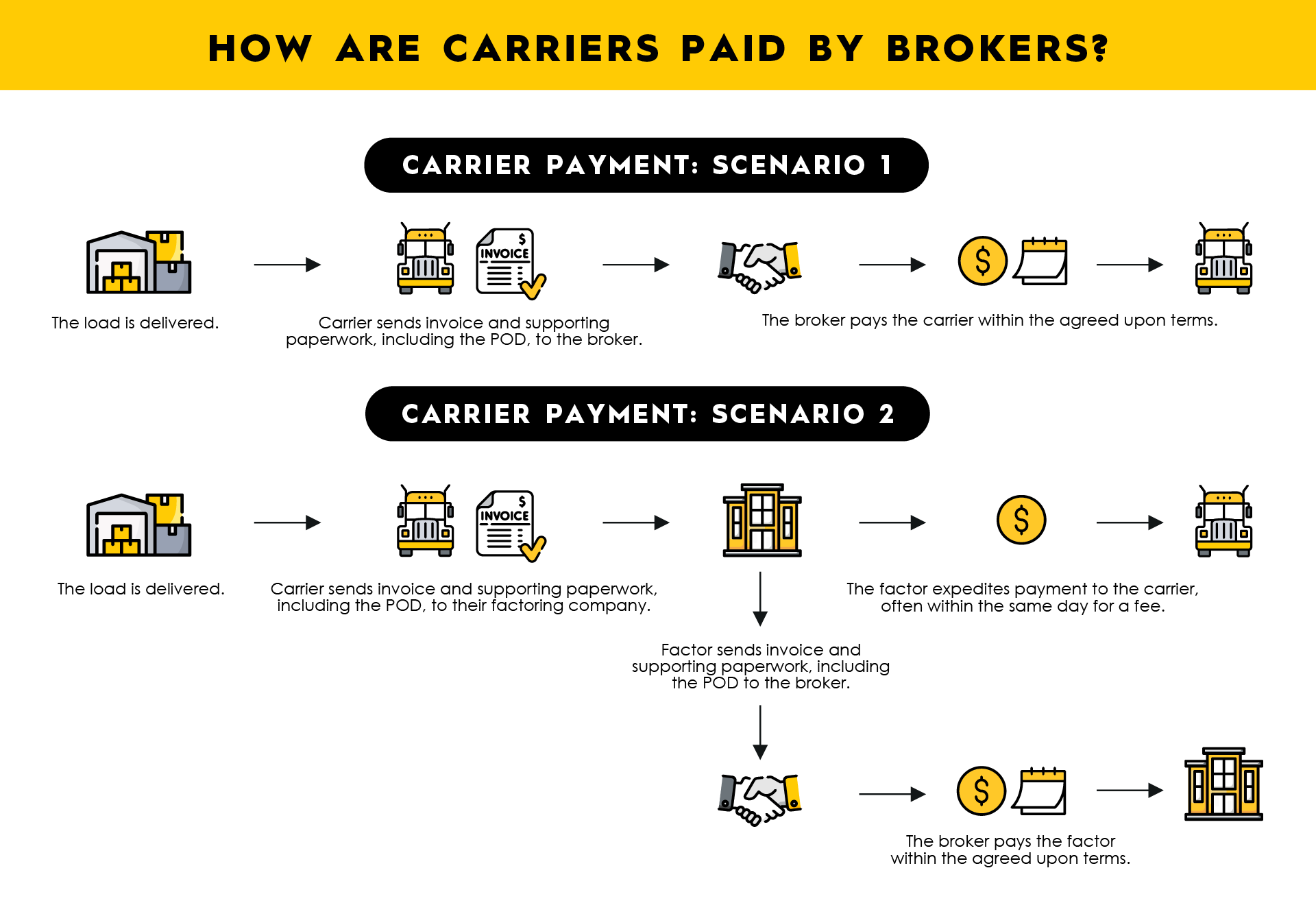
Carriers typically get paid by brokers in one of two ways. In the first scenario, the broker pays the carrier directly according to the agreed payment terms—for example, net 30 days. In the second scenario, the carrier chooses to work with a factoring company, which allows them to receive payment much faster, sometimes even the same day. The factoring company then collects the full payment from the broker under the original terms (i.e., net 30 days).
For more information, check out our whitepaper on leveraging factors and brokers to build financially resilient supply chains.
Yes, a broker can own and operate transportation equipment, using a team of company drivers. Additionally, some brokers may enter into contracts with owner-operators. In these arrangements, the owner-operator commits their equipment to haul exclusively for the broker, functioning similarly to a company driver while maintaining ownership of their assets. This set-up also allows owner-operators the flexibility to end the contract at their discretion when the agreement expires.
For example, TRAFFIX is considered an asset-lite broker as we operate a small fleet based out of our Canadian head office. Our fleet hauls freight across Canada and cross-border between the US and Canada. Alongside our in-house fleet, we secure contracts with owner-operators who haul exclusively for clients seeking dedicated assets on high-volume, consistent lanes. This approach allows clients to gain the benefits of both an asset-based carrier and broker — a topic we will explore further in this article.
Transportation intermediaries generally fall into three categories, with a few newer categories emerging.
| Brokers | 3PLs (Third-Party Logistics Companies) | 4PLs (Fourth-Party Logistics Companies) | |
| Key Differences: | Focus solely on connecting shippers with carriers. | Provides operational logistics services, including engineering transportation and warehousing solutions. | Manages the entire supply chain, often outsourcing to 3PLs and providing strategic oversight. |
| Role: | Acts as an intermediary (may or may not own equipment). | Offers a more comprehensive suite of services than a broker. | Focuses on supply chain optimization and integration, not just on executing shipments. |
| Services: | – Matches freight with available assets – Negotiates rates – Handles paperwork – Manages carrier network | – May offer managed transportation services using their own assets and/or contracted assets – Warehousing and inventory management – May offer value-added services such as freight forwarding, customs brokerage, and packaging – Supply chain consultation | – End-to-end supply chain management – Vendor and carrier management – Reporting and analytics used to provide recommendations for optimization – Supply chain consultation – RFP management – Invoice auditing – Fee payment – May provide – Transportation Management Software (TMS) |
| Benefits: | – Flexibility – Cost savings – Vetted carrier networks | – Comprehensive suite of services – Scalability – Operational efficiency | – Supply chain oversight – Engineers and implements supply chain optimization strategies – End-to-end supply chain management without adding headcount – Provide up-to-date technology |
Yes, some asset-based carriers may broker loads to other carriers when their freight volume exceeds their available capacity, and they prefer not to turn down shipments. While certain shippers insist on working exclusively with asset-based carriers, this situation is not uncommon and can introduce significant risks.
Choosing between asset-based carriers, brokers, 3PLs, and 4PLs depends on several supply chain factors such as shipment sizes, volume, geographic spread, timing, and your specific needs:
| Asset-Based | Brokers, 3PLs & 4PLs | |
| Coverage: | – Limited to their service area and by the number of owned assets. – Equipment types are limited to those in their asset pool. | – Extensive coverage through a vast network of thoroughly vetted carriers offering shippers scalability, flexibility and security. – Access to a wide range of equipment, including flatbeds, step-decks, reefers, dry vans, hot shots, and other specialized vehicles. – 3PLs and 4PLs (and some brokers) offer support with multiple modes including drayage, intermodal, warehousing, air and ocean freight. |
| Flexibility: | – Struggle with sudden changes in demand. – Excel in structured, consistent routes. – May grapple to recover loads when they experience a breakdown or accident in transit. – Last-minute load coverage is limited by their capacity. – May cause some asset-based carriers to broker. | – Can adapt quickly to changes in demand. – Handle volatile lanes with ease. – Can quickly solve problems on the road, such as sending new equipment to recover from breakdowns. – Excel when tendered last-minute freight with access to large networks of highly vetted carriers and broad coverage. |
| Quality: | Control the quality and maintenance of their own equipment. | Rely on strict carrier vetting to ensure quality and equipment maintenance. |
| Responsibility: | Own responsibility of the load. | Transfer responsibility of the load to the contracted carrier. |
| Drop Trailers: | – Can provide drop-trailer pools based on their trailer capacity and network location. – May lease additional equipment to supply sufficient capacity for a drop-trailer program. | 3PLs and 4PLs can provide flexible, high capacity drop trailer programs wherever they are needed. |
| Value: | Consistent, predictable pricing, but multiple providers are needed to deliver comprehensive coverage, requiring internal resources to manage. | One-stop-shop for comprehensive coverage where additional fees offset the need for an internal team. |
| Operating Hours: | Typically have fixed hours. | 3PLs and 4PLs typically offer 24/7 service. |
| Tracking: | Consistent tracking. | – Dependent on carrier technology and access to in-truck tracking equipment. – Can offer specialized devices such as Tive® trackers for a fee. |
Selecting the best option for your supply chain depends on factors such as freight type, volume, transit times, and your unique business needs. Asset-based carriers are well-suited for providing reliable, dedicated service on stable lanes with consistent volume. Meanwhile, brokers, 3PLs, and 4PLs offer greater flexibility in handling complex supply chains characterized by high-demand or unpredictable conditions. 3PLs and 4PLs bring specialized expertise and tailored solutions to enhance supply chain efficiency, reduce costs, and help shippers achieve their broader business objectives.
To discover how TRAFFIX can optimize your supply chain, contact us today!