TRAFFIX Recognized in the 2026 Gartner Finance Awards
Read More
Published: January 7, 2025
Last Updated: June 1, 2026

With the rise of nearshoring, shipping goods between Mexico, the US, and Canada offers significant opportunities but also introduces operational complexity. Success requires meticulous planning and specialized expertise to avoid delays, minimize costs, and ensure seamless transport of goods.
Cross-border transportation is not a single move at the border. It is a coordinated system involving documentation, regulatory compliance, carrier handoffs, and visibility across multiple jurisdictions. When these elements are not aligned, delays and disruptions compound quickly.
For a deeper dive into both best and worst practices, be sure to download our comprehensive whitepaper.
Mexico cross-border shipping is not a single transportation move – it’s a coordinated system involving multiple systems and stakeholders.
Unlike domestic freight, a cross-border shipment must move through two or more regulatory environments, transition between carrier networks on each side of the border, and, in the case of non-bonded shipments, clear customs before it can continue its journey. Transportation, documentation, and timing must align across all these steps for freight to move without interruption.
At its core, effective Mexico cross-border transportation depends on three fundamentals: clarity, compliance, and control.
When these three elements work together, the border becomes predictable.
Cross-border shipping works best when it is treated as a system, not as a series of disconnected steps.” – Erick Salinas
Most Mexico cross-border freight does not move from origin to destination on a single truck. Instead, it moves through a sequence of connected steps where timing and coordination are critical.
While the exact execution may vary by commodity and destination country, most Mexico cross-border shipments fall into four core stages.
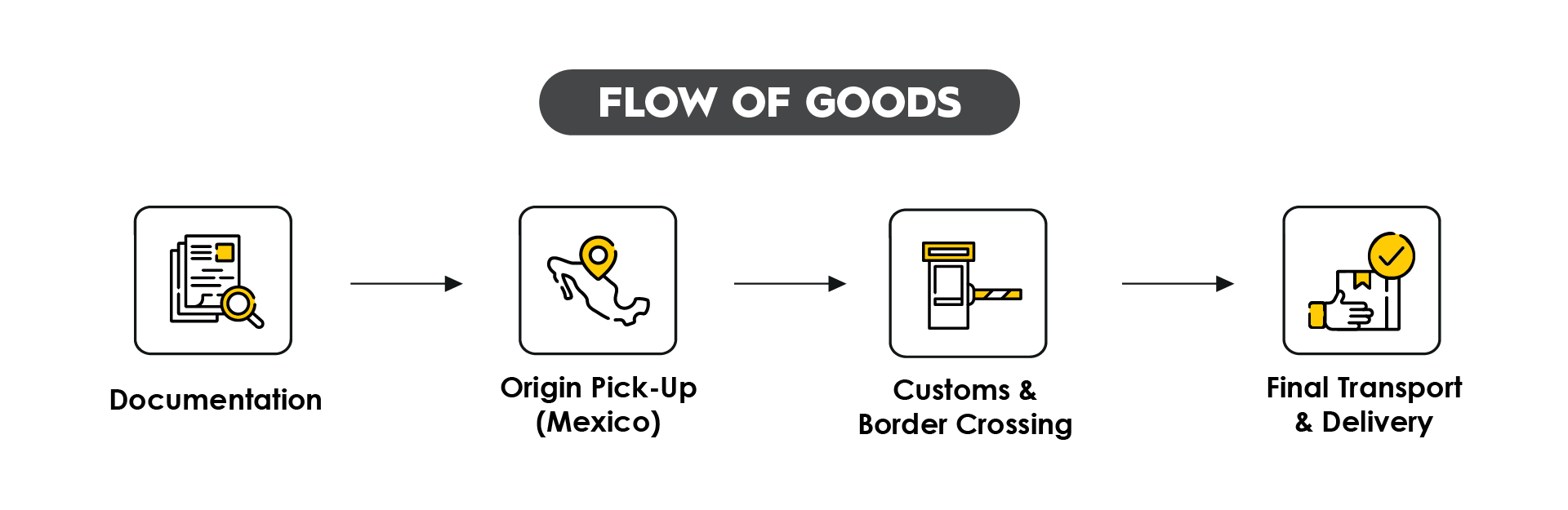
Before freight reaches the border, commercial invoices, classification details, Incoterms, and regulatory information must be prepared and validated.
If documentation is incomplete or inconsistent, the shipment may be subject to extended border waiting times or unnecessary inspections.
To get a full documentation checklist and step-by-step validation guidance, refer to the Mexico Cross-Border Transportation Whitepaper.
2. Origin pickup
Freight is collected at the shipper’s facility and moves through a domestic carrier network within Mexico toward the border.
Although the pickup carrier may occasionally move freight from Mexico into the U.S., often shipments are transferred to a specialized drayage carrier near the border. The drayage carrier transports the freight across the border following customs clearance and delivers it to a transload facility or onward carrier.
3. Customs
Carriers are required to submit an ACE (Automated Commercial Environment). Manifest at least one hour prior to arriving at the Mexico-U.S. border. The ACE Manifest enables U.S. Customs and Border Protection (CBP) to facilitate the efficient movement of compliant freight across the border while allowing potential issues to be identified early. Early visibility gives CBP time to address administrative or compliance concerns, helping to prevent border delays and port congestion.
It is strongly recommended that shippers or their customs brokers submit complete and accurate customs documentation at least one hour before the driver arrives at the border for processing. Proactive submission of documentation reduces dwell time and supports efficient port-of-entry operations.
For shipments moving from Mexico through the United States and continuing into Canada, an ACE Manifest is still required for entry into the U.S., even when a bonded carrier is used. Upon arrival at the U.S.-Canada border, the shipment must also have an ACI (Advance Commercial Information) eManifest submitted to enter Canada.
As a best practice, shippers should coordinate closely with their transportation partner to discuss transit timing. Transportation providers have visibility into current border wait times and can help determine optimal shipping windows to meet delivery deadlines.
4. Carrier handoff and final delivery
After clearing U.S. customs, the freight is transferred by the drayage carrier to a transloading facility in the United States, or to an onward carrier if transloading is not required. From there, the onward carrier picks up the freight and hauls it to the final destination within the U.S. or Canada.
In most cases, when freight originating in Mexico is destined for Canada, the shipment moves through the United States under an in-bond movement using a bonded carrier. This allows the freight to transit the U.S. without U.S. duties or taxes being assessed, since the shipment is not entering U.S. commerce.
When these steps are planned as a single system, cross-border transportation becomes controlled and repeatable. When they operate independently, small misalignments compound into significant delays.

Before moving freight across the Mexico U.S. or Mexico Canada border, shippers should evaluate their cargo carefully, as import and export requirements can vary significantly by commodity.
Certain products, such as fresh fruits and vegetables, often require additional permits and certifications beyond standard commercial documentation. These may include phytosanitary approvals, plant permits, food facility registrations, or other regulatory validations needed to comply with U.S. and Canadian customs requirements.
Country of origin considerations are also critical, as they determine eligibility for duty free or reduced duty treatment under trade agreements. While origin is typically straightforward for goods produced entirely in one country, it can become more complex when products contain components sourced from multiple locations.
At a basic level, customs brokers are responsible for:
These responsibilities ensure regulatory compliance, that the correct duties and fees are paid, and legal authorization for freight to move between countries.
However, the impact of customs brokerage extends beyond compliance alone – it also impacts transit time and on-time delivery.
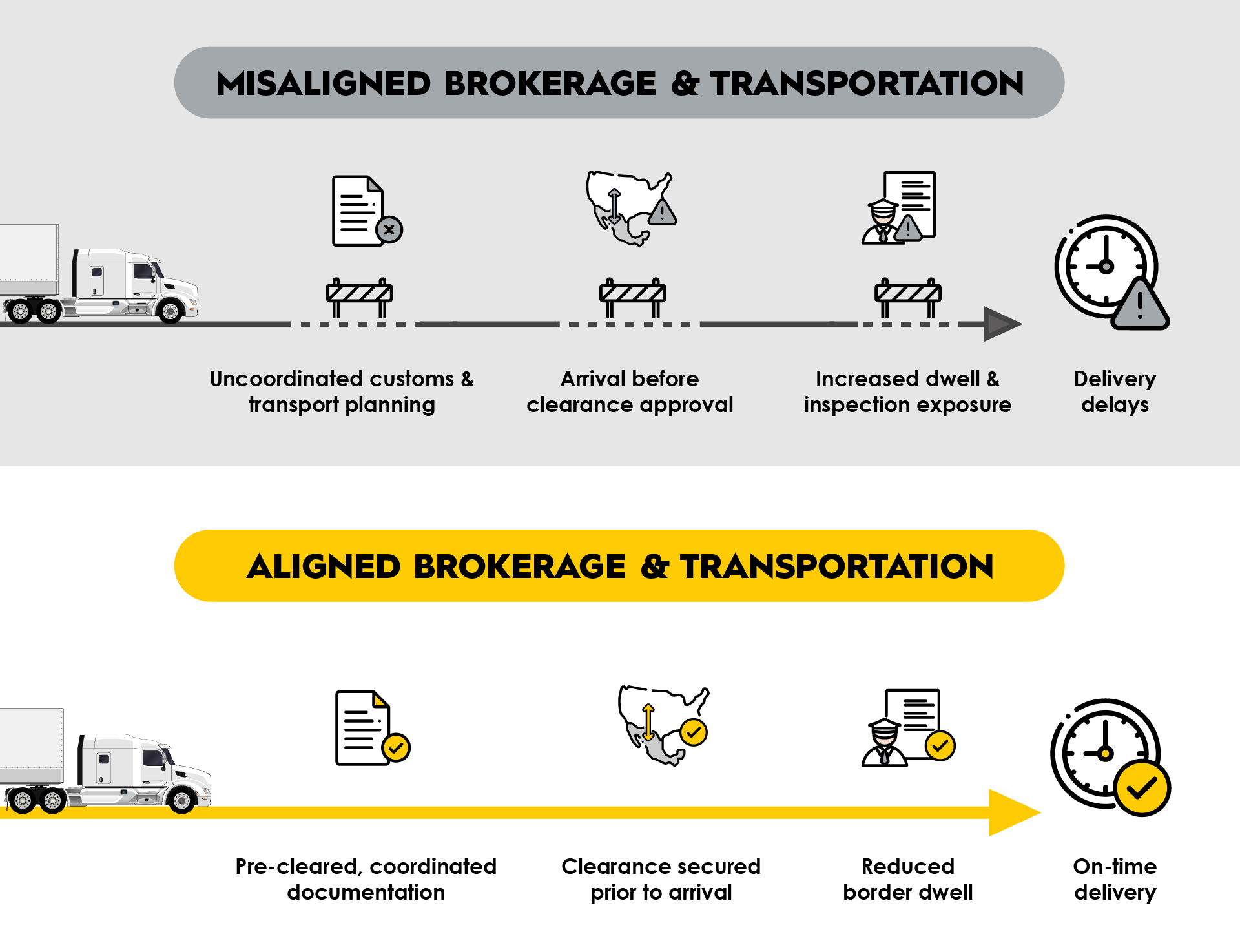
Complete and accurate customs documentation must be submitted to the appropriate border agency before freight physically arrives at the border. When brokerage activities are disconnected from transportation planning, shipments often arrive before they are legally ready to cross.
This misalignment creates avoidable dwell time, inspections, and congestion at the port of entry. Trucks wait. Delivery schedules slip. Minor documentation issues escalate into operational disruptions. The most effective cross-border operations treat brokerage, transportation, and communication as a single coordinated system. When these elements are aligned from the start, clearance supports movement instead of interrupting it.
When customs and transportation are aligned from the start, the border stops being a bottleneck and becomes a checkpoint.” – Erick Salinas
For a detailed overview of how to identify and choose a broker, along with the documentation requirements and submissions channels relevant to your supply chain, explore our Mexico Cross-Border Transportation Whitepaper.
The difference between smooth clearance and border delays often comes down to timing and coordination. When customs brokerage is integrated into transportation planning, freight moves efficiently. When it is not, delays compound quickly.
When moving freight between Mexico, the U.S., and Canada, expect expenses such as:
This article focuses on full truckload (FTL) shipments moving between Mexico, the United States, and Canada.
Full truckload modes include:
Depending on your shipping requirements, an alternative mode of transportation – such as less-than-truckload (LTL) or intermodal rail – may be a better fit.
| Transloading | Through-Trailer |
| Transloading involves transferring cargo from one trailer to another at the border. | Through-trailer shipping means the shipments stays on the same trailer from original to destination. |
| – Increased Carrier Capacity: Transloading opens up more carrier options, providing greater flexibility – Rate Flexibility: With more capacity, transloading can offer more competitive rates. – Minimal Impact on Transit Times: The transloading process typically adds only a few hours, making it a time-efficient option. | – Lower Capacity: Fewer carriers offer through-trailer service, limiting options. – Higher Rates: Limited capacity can drive up rates. – Slightly Faster Transit: Through-trailer shipping is usually only hours faster than transloading. – Seal Integrity Not Guaranteed: Customs inspections may require breaking security seals, as officials are authorized to open trailers. – Ideal for Special Handling: Through-trailer shipping is better for hand-loaded, fragile, high-value, or specialized cargo that may require unique equipment or minimal handling. |
Warehousing can play a strategic role in your Mexico cross-border supply chain.
Warehousing can be used to absorb timing mismatches between transportation legs where freight may clear customs before delivery windows are available, or when freight arrives ahead of production schedules to avoid congestion at the border.
Warehousing and cross-docking allow shippers to stage, consolidate, or sequence freight so that transportation modes work together more effectively. In cross-border environments, these facilities often serve as buffers that protect delivery schedules and inventory availability.
Understanding where warehousing fits into the cross-border flow helps shippers design transportation strategies that are resilient, not reactive.
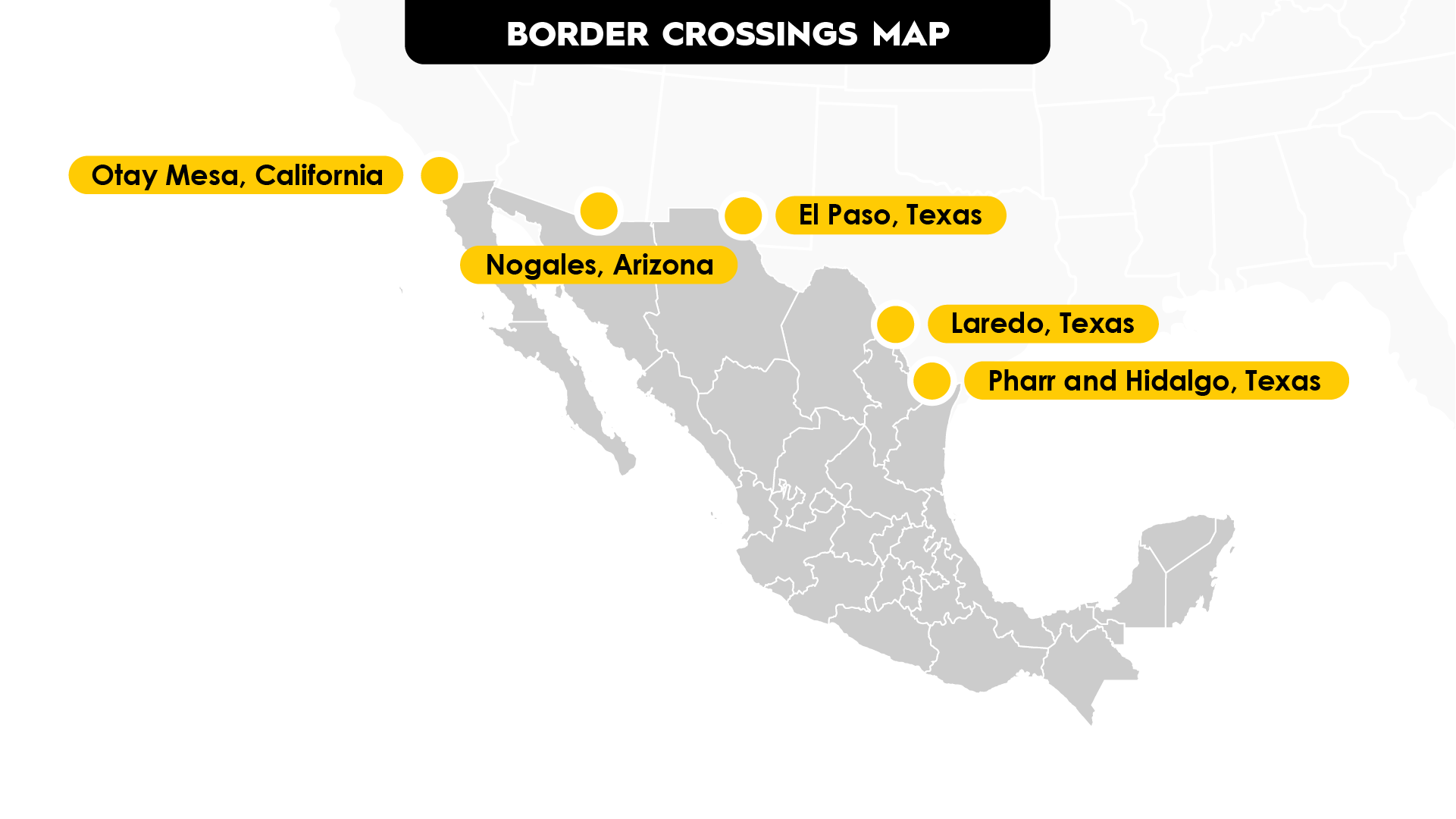
Mexico-US cross-border freight does not move through a single gateway. It flows through several major commercial border crossings, each supporting different industries and trade volumes.
While this section highlights major Mexico-US commercial crossings, shipments destined for Canada introduce additional routing and clearance considerations depending on the lane, carrier network, and final import requirements.
Understanding where freight typically crosses helps shippers anticipate congestion, plan timelines, and design more resilient cross-border strategies.
Some of the most active commercial crossing points include:
Each crossing operates with its own infrastructure, inspection patterns, and capacity constraints. No single crossing is ideal for every shipment.
The most successful cross-border strategies are built with flexibility in mind, not dependency on a single crossing.” – Erick Salinas
In certain cross-border scenarios, delays, handling errors, or visibility gaps can trigger operational and financial consequences. These shipments require a different level of planning and execution than standard cross-border moves.
Time-dependent production environments
Production schedules in manufacturing and nearshoring operations must be synchronized with inbound material deliveries. A delay at the border can halt assembly lines, disrupt labor planning, and create ripple effects across multiple facilities.
Additional considerations include:
Just-in-time (JIT) inventory models
JIT inventory strategies minimize on-hand inventory to reduce carrying costs, leaving little to no buffer for transportation disruptions. Even a minor delay at the border could immediately impact operations downstream.
Additional considerations include:
High Risk; High Value (HRHV) freight
High-risk, high-value shipments elevate the importance of security, custody, and visibility throughout the cross-border move. Multiple handoffs at the border increase risk if accountability and monitoring are not clearly defined.
Additional considerations include:
Temperature-controlled shipments
Produce, food, and pharmaceutical shipments require uninterrupted temperature management and regulatory compliance throughout transit. Border delays introduce risk of temperature excursions that can permanently compromise product integrity.
Additional considerations include:
In these scenarios, cross-border shipping becomes less about cost optimization and more about continuity, protection, and control. Success depends on selecting the right transportation partners, implementing tighter operational controls, and planning proactively for border-related risks that standard truckload shipping models may not adequately address.
Most Mexico cross-border disruptions are preventable. They rarely happen because the border itself is difficult. They happen when preparation, communication, or coordination breaks down at key points in the process.
The most common causes include:
Documentation errors
Even minor inconsistencies in commercial invoices, classifications, or shipment details can trigger customs holds or inspections. When documentation is corrected after freight has already reached the border, delays become difficult to recover.
Limited cross-border visibility
Shipment tracking in Mexico cross-border transportation can be challenging, as visibility often diminishes when freight transitions between countries or service providers. Multiple carrier and driver handoffs make tech-tracking difficult to coordinate. Without consistent visibility, issues may go unnoticed until they escalate, limiting the ability to respond proactively. Partnering with a transportation provider that prioritizes communication and maintains a dedicated tracking team is one of the most effective ways to ensure reliable shipment visibility.
Communication gaps between transportation providers and customs brokers
When carriers and customs brokers operate in silos, timing misalignments increase. Freight may physically arrive at the border before it is legally cleared, creating avoidable dwell time and confusion around accountability.
This breakdown most often occurs when documentation submission, inspection timing, and drayage coordination are treated as separate tasks instead of a single execution flow.
Border congestion and dwell time
Congestion at the border amplifies even minor planning gaps. Without proactive planning, terminal backlogs and inspection queues introduce unpredictable delays that ripple through production and delivery schedules.
Compliance risk
Regulatory requirements evolve continuously. When compliance expertise is outdated or fragmented, exposure increases quietly until it results in fines, shipment holds or forced process changes.
Taken together, these issues do not occur in isolation. One breakdown often triggers another, compounding delays and increasing both operational and financial risk.
The border itself is rarely the problem. The problem is what happens before freight ever gets there.” – Erick Salinas
When cross-border shipping is designed intentionally, shippers gain clarity and confidence at every stage of the move. The process becomes structured – not rushed, reactive, or opaque. Each step of the execution supports the next, creating a connected system that reduces risk and improve performance.
Effective Mexico cross-border transportation begins with planning and validation. Shipment details and customs documentation are reviewed before pickup, not after freight is already in transit. Early validation reduces the risk of delays once the shipment reaches the border.
Next, carrier assignments is approached strategically. Carriers are selected based on cross-border authorization authority and experience, ensuring they are both permitted and prepared to operate within both multiple regulatory environments.
Throughout the move, in-transit visibility remains continuous. Freight is monitored across countries, with consistent communication and status updates. Visibility does not stop at the border, allowing potential issues to be identified and addressed before they escalate.
Finally, the process concludes with delivery confirmation and performance review. Proof of delivery is shared promptly, and shipment performance is evaluated to identify improvement opportunities for future cross-border moves.
When these steps function as an integrated process, cross-border transportation becomes predictable rather than reactive.
Mexico cross-border shipping introduces complexity, but it does not have to create uncertainty. When clarity, compliance, and control work together, the border becomes manageable. When cross-border transportation is designed as a system – rather than treated as a series of individual moves – it becomes repeatable, reliable, and easier to plan around.
Mexico cross-border shipping is a form of international transportation. Within TRAFFIX’ service offering, Mexico cross-border specifically refers to freight moving between Mexico, the United States and Canada.
Customs clearance timelines vary by shipment. While there is no guaranteed timeframe, best practices suggest submitting complete and accurate customs documentation at least one hour before the shipment arrives at the border. Clearance time depends on factors such as documentation accuracy, inspection requirements, and border congestion. Preparation significantly reduces delays.
While some cross-border truckload shipments are transloaded at the border, others move using tractor swaps or through trailer service. The approach depends on carrier authority, equipment availability, lane structure, and operational requirements. In certain cases, the same trailer may be picked up in one country and delivered in another without being transloaded.
Yes. Cross-border shipping can be planned and managed on a long-term basis, particularly for shippers with consistent volumes, established lanes, and predictable demand. Many companies operate daily or weekly cross-border lanes using repeatable processes built around standardized documentation, vetted carrier partners, and predefined border procedures.